

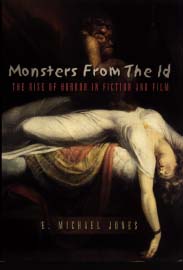
 Excerpts from reviews of Monsters
From the Id: The Rise of Horror in Fiction and Film ($24.95 + S&H) by E. Michael Jones, Ph.D.
Excerpts from reviews of Monsters
From the Id: The Rise of Horror in Fiction and Film ($24.95 + S&H) by E. Michael Jones, Ph.D.
... strikingly original and insightful ... Jones’ message is
encouraging: this book gives you proof after proof that the eternal truths
conservatives defend today can never be wholly or successfully discarded. For
Jones explains that desire for repentance — however inchoate — underlies all
horror literature and movies. He shows how in his eye-opening and fascinating
analyses ..." National Review
Book Service.
"E. Michael Jones advances a fascinating thesis. Horror fiction, he
argues, grew out of the sexual decadence of the Enlightenment. ... The warning
of these films is that "sex disconnected from the moral order is
horrifying," Jones writes. This Halloween, when your kids want to rent a
horror film, don’t let them. Instead, sit down with them—and with the
neighbor’s kids, as well—and explain where horror films really come from and
why they are perverse. It’s a great way to expose the cultural lies that are at
the root of our society’s celebration of horror." Charles Colson, CBN,
Breakpoint Online.
"Another excellent work from one of America's leading Revisionist
historians. Jones ... has convincingly traced the Enlightenment ideology in
Western Europe from promises of freedom to the agony of unrestrained passions.
For Jones, this agony is most vividly represented in American culture in the
horror genre, which is unmistakably the unique product of modern Western
ideology." M. Raphael Johnson, The Barnes Review.
"Jones' thesis shouldn't be all that surprising. Scholars and critics have
acknowledged that horror is an artistic representation of our fears and
anxieties. Jones' contribution is to tell readers that we are afraid and
anxious because we know that our morality not only doesn't work, but it's also
the source of evil and suffering. Since, like Mary Shelley, we can't or won't
acknowledge that fact, the monster will be hear to stay, and investigating
strange noises will remain a bad idea." Roberto Rivera, belief net.
"Jones makes astute observations, as when he links Bram Stoker's Dracula
to the 19th-century fear of syphilis ... ." Publishers Weekly.
"... a fresh and deeply compelling look not only at the horror genre
itself but the culture that has spawned it as well. Author E. Michael Jones
(PhD) succeeds in defining what truly lays at the heart of horror’s appeal: the
innate and primal enjoyment of reading or viewing the violation of eternal
truths and the consequences suffered by innocent and guilty alike for those
transgressions – until balance is restored to a moral universe once again. Or
in short, evil running amok until it is vanquished in the last chapter (or
final reel). ... bracingly provocative ... certainly a departure from the endless
p.c. bogus subtexts readers are regularly subjected to when reading studies of
the horror genre. ... Dr. Jones brings us back on track: the transgressions of
Science with respect to Life, the consequences of Enlightenment hubris, the
dismissal of the Sacred and the abandonment of God created a reaction in the
world of literature (and later film) that we now call the 'Horror' genre. These
are the true subtexts to be found in any serious critique. And why are they
always there? Because ever since the Enlightenment when Man replaced God’s
morality with his own, he has suffered the consequences of it. Our ‘rational’
control of nature has set free 'Monsters from the Id' and these stories appeal
to the latently ingrained moral compass written on every man’s heart. ... this
book offers a welcome respite from the navel-gazing silliness so often
encountered by those writers who seem to lack a grounded historical
perspective." David Yuers, Cult Movies magazine.
"... consistently provocative
and informative ... " Douglas Wilson, Credenda.
" ... offers a refreshing counterpoint to other self-proclaimed experts in
the horror genre with their own agendas. ... Jones has a clear view of the issues
at hand. ... brass-balled temerity ... " Greg Goodsell, The Blackboard.
"Did you know that horror arose
in the sexual decadence which followed the French Revolution? This context
leads Michael Jones to argue that horror is a product of a guilty conscience that
will not own up to its wrongdoing. In short, Jones argues that the
Enlightenment sought to destroy religion and morality only to see them return
in the form of monsters and evil. The antidote, according to Jones, is a fresh
acknowledgement of the demands of an objective moral order. … Jones is also the
author of the highly acclaimed trilogy on modernity: Degenerate Moderns,
Dionysos Rising, and Living Machines." Reformation
& Revival Journal.
"Frankenstein, Dracula, and
other horror stories have something valuable to tell us about the consequences
of breaking taboos." Nick Eicher, Behind the Headlines.
"... Buffy[, The Vampire Slayer] is a horror show, albeit a quirky,
postmodern kind of horror show. In his new book, Monsters From The Id: The Rise
of Horror in Fiction and Film, cultural critic E. Michael Jones writes that
horror is both "a sign that we don’t know what is bothering us" and
"a sign that we don’t want to know to know what is bothering us." By
"what is bothering us," Jones is referring to a sense that the
worldview and accompanying morality that supplanted the Judeo-Christian
worldview and morality not only violates the laws that govern the universe, but
is also the source of much suffering and evil. Jones traces the rise of modern
horror to the Enlightenment’s "[tearing down] of those institutions that
has regulated human behavior." In their place, the Enlightenment
substituted human reason — a reason that, as Jones writes, "could do
nothing to prevent [itself] from disintegrating into and justifying pure
desire, even destructive desire." In other words, without Christianity,
there was nothing to keep Western man from acting on his worst impulses, and
what’s more, rationalizing those impulses. Thus, as Jones contends, personal
liberation, among the notables of the Enlightenment, was understood in largely
sexual terms." Roberto Rivera, Boundless
Webzine.
" ... provocative ..." Steven D. Greydanus, National Catholic
Register.
Share |
| Home | Books | e-books | Events | DVDs/CDs | Subscribe | Donate |
Culture Wars • 206
Marquette Avenue • South Bend, IN 46617 • Tel: (574) 289-9786 • Fax: (574)
289-1461
Copyright